Your Brain Is Writing Checks Your Body Can't Cash: The Sensory Gap in Force-Feedback Training
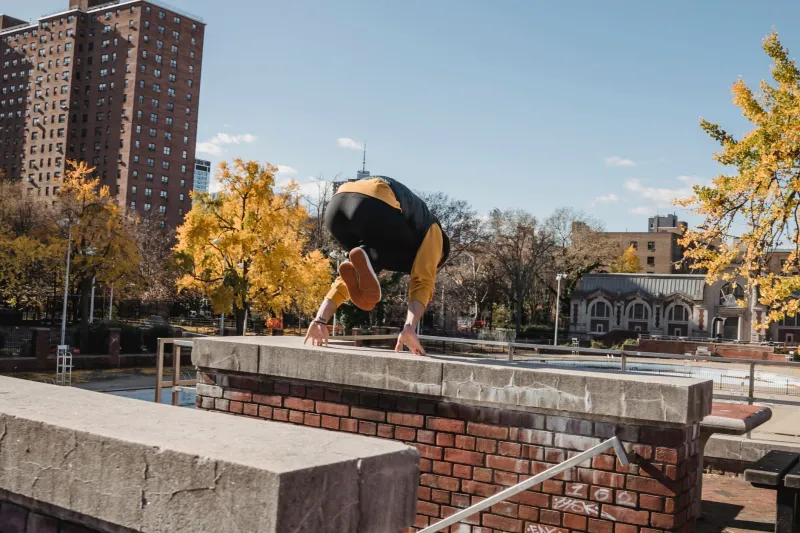
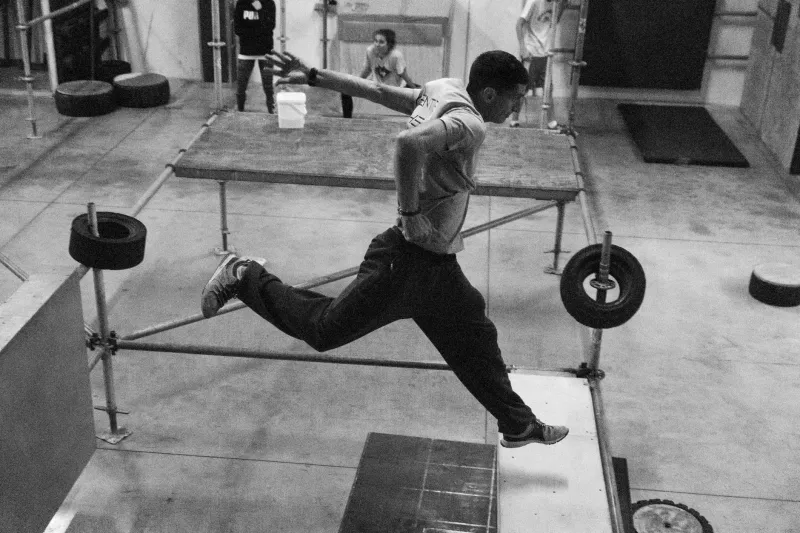
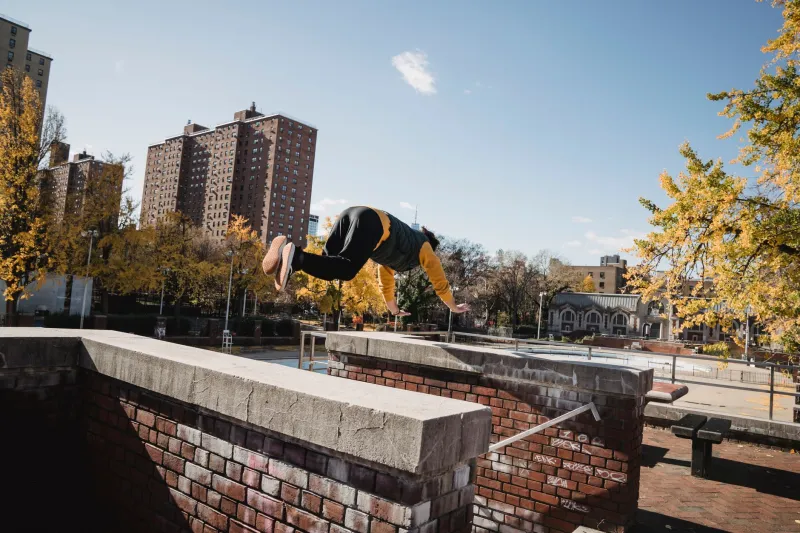
There's a moment every parkour athlete knows. You've run a line in your head a hundred times — maybe in a game, maybe in VR, maybe with a force-feedback rig that buzzes and resists and generally does its best impression of physics. Then you're standing on the actual ledge, and your body does something your brain didn't authorize. It hesitates. Or worse, it commits wrong.
That gap — the space between what your controller told you and what the ground is actually saying — has a name in neuroscience. Researchers call it a proprioceptive mismatch. Out here in the movement community, we're just starting to reckon with what it actually costs.
What Proprioception Actually Does (And Why Controllers Can't Fake It)
Proprioception is your body's internal GPS. It's the constellation of signals coming from your muscles, tendons, joints, and skin that tells your brain exactly where you are in space without you having to look. Elite parkour athletes develop an almost absurd level of proprioceptive resolution — they can feel the angle of a rail through the sole of a shoe, sense a surface's give in the split second before full weight transfer, and make micro-corrections mid-air that happen way too fast to be conscious decisions.
Haptic feedback systems — from the adaptive triggers on a PlayStation 5 DualSense to full-body motion suits with vibrotactile arrays — are genuinely impressive pieces of engineering. They can simulate texture, resistance gradients, and impact force with surprising fidelity. But here's the problem: they're feeding that information into the wrong channels.
A controller buzz hits your fingertips and palms. A motion rig might shake your torso or compress your legs. None of that is the same as 180 pounds of body weight loading onto a single foot planted on a sloped concrete surface at speed. Your nervous system isn't fooled. It registers the haptic signal as information, sure — but it files it in a completely different drawer than real proprioceptive data.
The Phantom Feedback Loop
Here's where it gets genuinely weird. Repeated exposure to haptic simulation can actually start to reshape your movement expectations. Sports scientists studying motor learning have documented what some call "phantom proprioception" — situations where the brain has been conditioned to anticipate a certain sensory response to a movement, and when that response doesn't arrive (or arrives differently), execution degrades.
Think about it like this: if you've run a precision jump in a parkour game three hundred times and the haptic trigger gives you a satisfying resistance click at the moment of landing, your motor cortex starts building that click into its internal model of what a successful landing feels like. You're not just learning the movement — you're learning a corrupted version of the movement, one that includes a sensory cue that doesn't exist in the real world.
When you step outside and stick that same jump on actual concrete, the expected signal never comes. Your brain, running its checklist, gets a mismatch notification. And in the half-second it takes to reconcile that, your body may already be making compensatory adjustments you didn't intend.
The Athletes Already Feeling This
Coaches working with athletes who cross between digital training environments and real-world practice are starting to report consistent patterns. Vaulters who spend heavy time in motion-controlled game environments sometimes show a specific timing hesitation on takeoff — not from fear, but from what looks like a sensory anticipation lag. Freerunners using force-feedback rigs for repetition training occasionally develop what one West Coast coach described to us as "ghost landing syndrome" — a slight over-absorption on real landings, as if the body is bracing for an impact that never quite arrives the way the rig taught it to.
None of this means force-feedback training is worthless. Far from it. The visualization benefits, the repetition volume, and the fear-reduction value of virtual environment training are real and well-documented. But there's a cost to ignoring the sensory translation problem, and right now most training programs aren't accounting for it.
Bridging the Gap: What Actually Works
The smartest coaches in the hybrid training space are building deliberate "recalibration" protocols into their programs — structured real-world sessions specifically designed to flush out the proprioceptive drift that builds up during heavy virtual training blocks.
The core principle is contrast exposure. You run a movement in the virtual environment, then immediately execute a structurally similar movement in a real, low-stakes physical context. The goal isn't to replicate the exact line — it's to give your nervous system a chance to reconcile the two sensory vocabularies before the gap widens too far. Think of it as cross-training for your sensory system rather than just your muscles.
Some practitioners are also experimenting with reduced haptic feedback during training — deliberately dialing down the controller's response to stop the brain from anchoring to artificial sensory cues. The logic is counterintuitive but sound: if the haptic signal isn't strong enough to become a learned expectation, it can't create a mismatch problem downstream.
There's also growing interest in training with intentionally mismatched feedback — running movements where the haptic response is deliberately offset from the visual cue. The idea is to train the brain to treat haptic data as supplementary information rather than ground truth, which may reduce the phantom feedback effect when athletes transition to real surfaces.
The Bigger Question for the Industry
Force-feedback hardware is evolving fast. Full-body haptic suits are getting cheaper, more granular, and more immersive. Game developers are investing serious resources into making virtual environments feel physically convincing. That's exciting — but it also means the sensory gap problem isn't going away. If anything, it's going to get more pronounced as the simulation gets more persuasive.
The parkour and freerunning community has always been brutally honest about the gap between what looks right and what works. That same honesty needs to show up in how we evaluate digital training tools. A controller that makes your hands feel something isn't the same as a surface that makes your whole nervous system feel everything. The difference matters. And right now, the only way to close it is to keep getting outside and letting the concrete do the teaching.
Your brain will catch up. You just have to give it real data to work with.