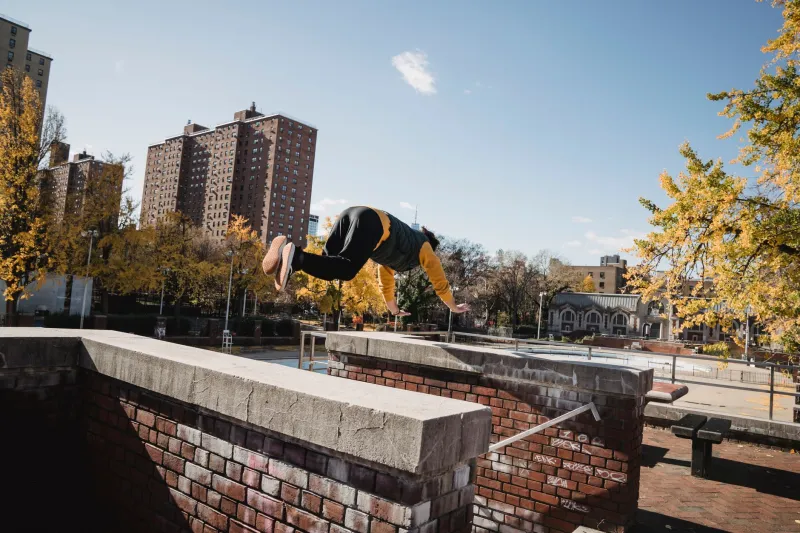
Frame Data on the Street: How Fighting Game Logic Is Rewiring the Way Parkour Athletes Train
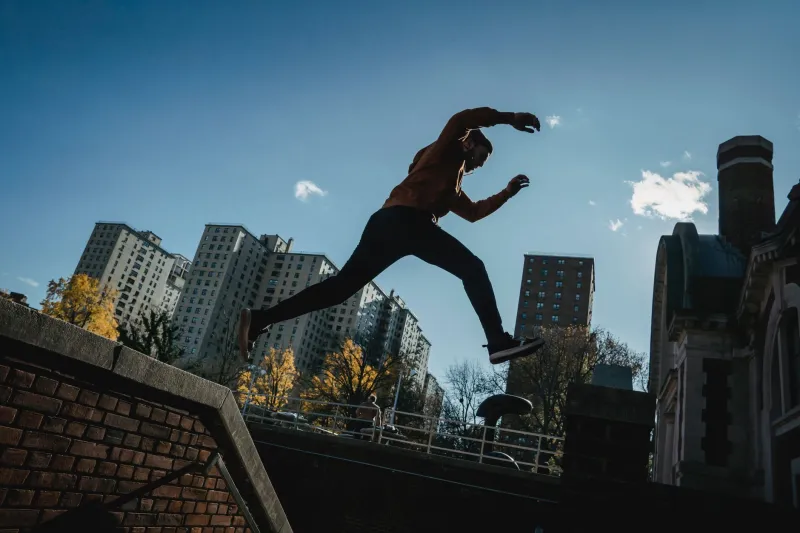
There's a moment in almost every serious Street Fighter or Tekken match where the difference between a punish and a missed window comes down to a single frame — one sixtieth of a second. Get it right and you look like a genius. Blow it and you eat a combo. Competitive fighting game players have built entire training philosophies around that margin. Now, a surprising number of parkour athletes are doing the exact same thing on rooftops and rail yards across the US.
Call it the precision paradox. The sport that built its identity on unbroken flow — the romantic idea of moving through an environment like water finding its path — is quietly developing a subculture obsessed with hard stops, measurable micro-transitions, and repeatable frame-perfect timing. And depending on who you ask, that's either the most exciting evolution parkour has ever seen, or a slow-motion betrayal of everything the discipline was supposed to be.
Where the Obsession Started
The thread connecting fighting games to movement sports isn't as random as it sounds. Speedrunning culture planted the seed. Athletes who spent their off-hours grinding game routes started importing the vocabulary — input windows, optimal pathing, frame counts — into how they analyzed their own movement. When you've spent 200 hours shaving milliseconds off a Super Mario 64 run, you start seeing your precision jump to a rail differently. You stop asking "did that feel smooth?" and start asking "was that the earliest possible takeoff?"
That mental shift is exactly what athletes like Denver-based mover Caleb Torres describe when they talk about their current training approach. "I used to just run lines until they felt right," Torres explained in a recent interview. "Now I'm filming every session, going back frame by frame, and asking why I'm absorbing an extra two steps on a landing when I could be redirecting on the first contact. That's not a vibe thing. That's mechanics."
Torres isn't alone. Across competitive circles in cities like Chicago, Atlanta, and LA, athletes are adopting what some are calling a "frame-data mindset" — the practice of breaking movement into discrete, measurable windows rather than evaluating it as a continuous experience.
What Frame-Data Thinking Actually Looks Like in Practice
In fighting games, frame data tells you exactly how many frames a move takes to start, how long it's active, and how long you're vulnerable afterward. It's cold, clinical, and completely divorced from aesthetics. Applied to parkour, the equivalent thinking goes something like this: a precision jump to a narrow ledge has an optimal takeoff window of roughly two to three steps before the edge. Land inside that window and your body's momentum carries cleanly into the next movement. Miss it by even a half-step and you're either over-committing or pulling up short, costing you energy and time on every subsequent move in the line.
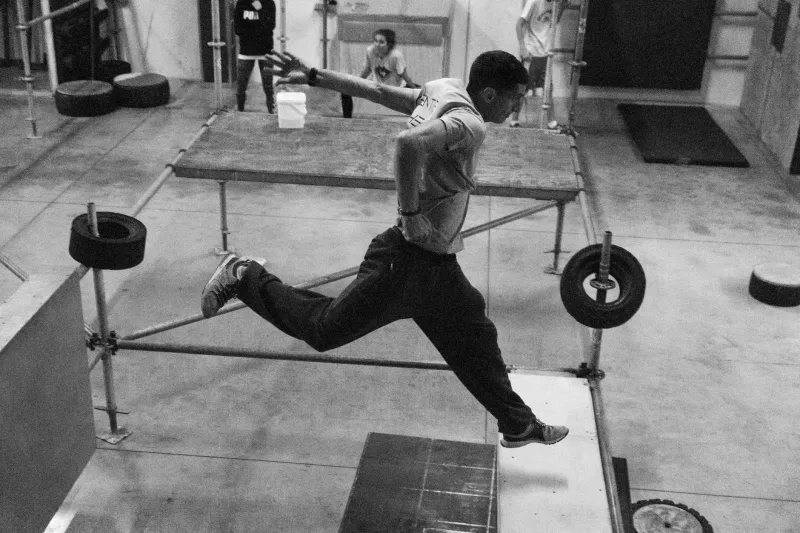
Athletes training this way use slow-motion footage — most modern smartphones shoot at 240fps or higher — to identify exactly where their timing breaks down. Some are even using external tools borrowed from esports performance labs, including reaction time apps and rhythm trainers, to sharpen the split-second decisions that determine whether a transition is clean or sloppy.
Phoenix-based coach and former competitive athlete Maya Hendricks has been integrating this approach into her training programs for about two years. "The biggest thing I've noticed is that athletes who think this way make fewer errors under pressure," she said. "When you've drilled a movement to the point where you understand the exact window you're working in, you stop second-guessing mid-air. That's not robotic — that's confidence built on actual data."
The Community Isn't Exactly Thrilled About All of It
Here's where the paradox part kicks in. Parkour's cultural DNA is deeply rooted in the idea that movement should be expressive, adaptive, and fundamentally human. The original practitioners in France weren't timing their vaults with stopwatches — they were responding to environments intuitively, letting the body lead. A significant portion of the community views the precision obsession as a kind of category error, importing competitive esports logic into something that was never supposed to be a performance sport.
The critique isn't just philosophical. Some coaches argue that over-indexing on frame-perfect timing actually increases injury risk for intermediate athletes who aren't physically prepared to execute movements at maximum efficiency on demand. "If your technique isn't solid, drilling precision just means you're repeating a flaw faster," said one East Coast coach who asked not to be named. "Flow training builds in natural error correction. When you're always chasing the optimal window, you stop listening to your body."
There's also a genuine tension around what competitive parkour even is. Speed runs, jam sessions, and art du déplacement exhibitions all value different things. The frame-data crowd tends to cluster around timed formats and obstacle course competitions — contexts where measurable efficiency matters. But those formats represent only a slice of how most people actually practice.
The Speedrunning Pipeline Is Real
What's undeniable is that the pipeline between gaming culture and movement sports is running hotter than ever. Athletes who grew up speedrunning games bring a specific analytical toolkit with them when they step outside. They're comfortable with repetition. They understand optimization as a value, not a constraint. And they're not intimidated by the idea that something beautiful can also be technically dissected.
For that cohort, the precision movement isn't a betrayal of parkour — it's an extension of the same drive that makes you grind a boss fight for three hours to save four seconds on a run. The goal isn't to make movement look robotic. It's to make it so dialed in that it looks effortless.
Torres puts it simply: "Flow isn't the opposite of precision. Flow is what happens when your precision is good enough that you stop thinking about it."
Where This Goes From Here
The honest answer is that both camps are probably going to keep existing in parallel, which is fine. Parkour has always been big enough to hold multiple philosophies. What's interesting is watching the tools and vocabulary of one world — competitive gaming, speedrunning, esports performance science — find genuine traction in a discipline that started on the streets of Paris with no equipment and no metrics at all.
If anything, the crossover is a sign that the lines between digital movement culture and physical movement culture are blurring faster than most people expected. And at F-Jump, that's exactly the kind of leap worth paying attention to.