Sweat Between Rounds: The Hybrid Tournament Scene Blending Esports With Real-World Obstacles
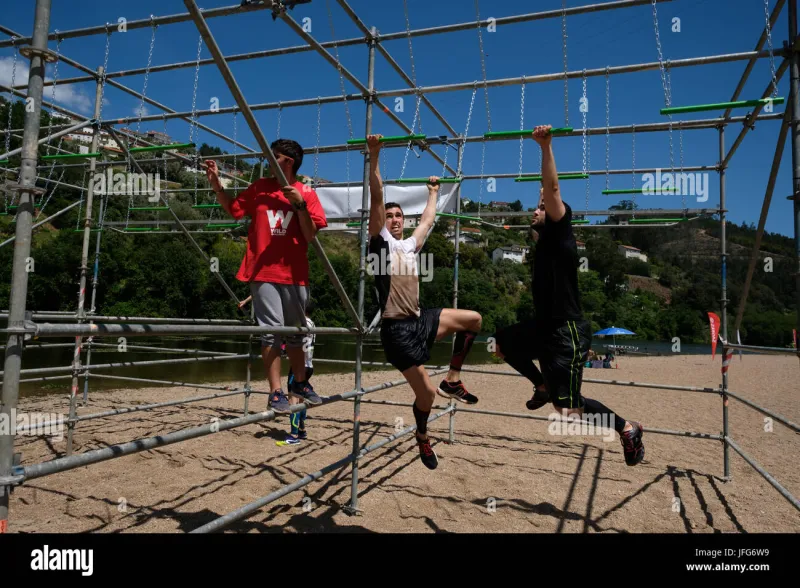
Photo: young athletes gaming competition obstacle course urban warehouse event, via c8.alamy.com
The setup sounds like something a PE teacher dreamed up after losing an argument with a Twitch streamer: competitors run a timed parkour obstacle course, then immediately sit down and play a competitive match of a first-person shooter. Best combined performance wins.
And yet, in warehouses and community centers from Atlanta to Portland, this is exactly what's happening—and the people showing up aren't doing it reluctantly. They're driving hours for it.
Welcome to the hybrid tournament circuit, one of the weirder and more compelling corners of American youth culture right now.
How This Actually Works
The formats vary depending on who's running the event, but the core concept is consistent: physical performance and digital performance are scored together, creating a composite result that neither a pure gamer nor a pure athlete can dominate without developing both sides of the equation.
At some events, the physical component acts as a time modifier—complete the obstacle course faster, and you get a head start or a handicap advantage in the gaming round. At others, the two disciplines are scored on entirely separate rubrics and added together. A handful of organizers have experimented with interleaving them, requiring competitors to complete a physical challenge between each in-game match—think: finish your round in Valorant, then hit a vault sequence before the next one loads.
The obstacles themselves range from purpose-built parkour structures to improvised setups using gymnastics equipment, plyo boxes, and whatever the venue had lying around. Production quality varies wildly. That's kind of the point right now—this scene is still in its garage-band era.
The People Building It
Marcus Webb has been running hybrid events out of a converted industrial space in Columbus, Ohio for about two years. He came up in the local parkour scene before getting into competitive gaming, and the hybrid format was his attempt to stop feeling like he had to choose between the two worlds.
"The gaming community thought I was trying to punish them," he says with a laugh. "And the movement guys thought I was trying to make parkour into something nerdy. Both of them were wrong, and both of them came back for the second event."
His events now draw around 80 to 120 competitors per session, with a waiting list that's been building since early this year. He charges a small entry fee, keeps the format flexible, and films everything for social content—which, predictably, is where most of his new participants find out the events exist.
On the West Coast, a collective called Grid & Ground has taken a more structured approach. They've developed a formalized scoring rubric, partnered with local parkour gyms for venue support, and begun conversations with a regional esports league about potential integration. Their vision is explicitly competitive—they want to see hybrid events on a sanctioned circuit within three years.
"We're not anti-gaming," says one of the collective's co-founders, who goes by Sable online. "We're pro-body. We think the best version of esports culture is one where the players are also physically capable humans, and we're building the format that makes that possible."
What the Researchers Are Saying
The grassroots energy behind this movement is getting some attention from academics who study youth physical activity and engagement. The underlying challenge they're trying to solve is well-documented: sedentary behavior among American teenagers has been climbing for years, and traditional sports programs—with their tryouts, travel costs, and time commitments—aren't reaching the kids who most need physical engagement.
Gaming already has those kids' attention. The question researchers have been asking is whether that existing engagement can serve as a bridge to physical activity rather than a barrier to it.
Early signals are cautiously encouraging. A small but growing body of research on "exergaming"—games that require physical movement to play—suggests that when digital and physical activity are genuinely integrated rather than just loosely adjacent, participation rates in the physical component stay higher than when movement is presented as a separate, mandatory chore.
The hybrid tournament model takes that logic further. It's not asking kids to exercise before they get to play games. It's telling them that their physical performance is part of their competitive identity—that being fast and coordinated on an obstacle course makes them a better competitor overall. That framing shift appears to matter.
The Skeptics Have a Point
Not everyone is sold on the concept, and the criticisms are worth taking seriously.
From the traditional esports side, there are legitimate concerns about accessibility. Competitive gaming has always been appealing partly because it's a space where physical ability doesn't determine outcomes—players with disabilities, players who don't fit the conventional athletic mold, players who found community in gaming because it wasn't gym class can all compete on equal footing. Adding a physical component risks excluding exactly those people.
The more thoughtful hybrid event organizers are grappling with this directly. Some are building in accommodation tracks or separating the physical and digital scoring entirely so that competitors can choose their emphasis. Others argue the solution is making the physical component more about creative movement than raw athleticism—parkour's foundational ethos, after all, is that movement is for everyone, not just the conventionally fit.
From the parkour community, there's a different kind of skepticism: concern that reducing movement to a tournament metric misses what makes the discipline meaningful. Parkour at its core is about personal progression, environmental reading, and a relationship with space that doesn't translate cleanly into a timer and a point system.
That tension is real. Whether the hybrid format can honor what makes both disciplines valuable—rather than flattening both into competitive spectacle—is probably the most important question the scene hasn't fully answered yet.
Why It Might Actually Scale
Here's what makes the cynics' job harder: the footage is incredible. Watch a competitor blast through a vault sequence and then immediately drop into a focused gaming setup, hands still slightly shaking from adrenaline, and you're watching something that doesn't look like anything else in competitive culture right now. It's genuinely compelling content, and in 2024, compelling content has a way of building its own infrastructure.
Brand interest is starting to follow. A few energy drink companies and one mid-size gaming peripheral brand have quietly reached out to organizers about sponsorship arrangements. Nothing formalized yet at the circuit level, but the conversations are happening.
More importantly, the participants keep coming back. Marcus Webb's retention numbers—the percentage of competitors who return for a second or third event—are high enough that he's started thinking about what a regional expansion would look like. Grid & Ground is already talking to organizers in Denver and Chicago.
The hybrid movement is still small, still scrappy, and still figuring out its own rules. But it's solving a real problem: how do you build competitive formats that treat physical capability and digital skill as genuinely complementary rather than mutually exclusive? For a generation that grew up doing both simultaneously, that question might not be as hard as it sounds.